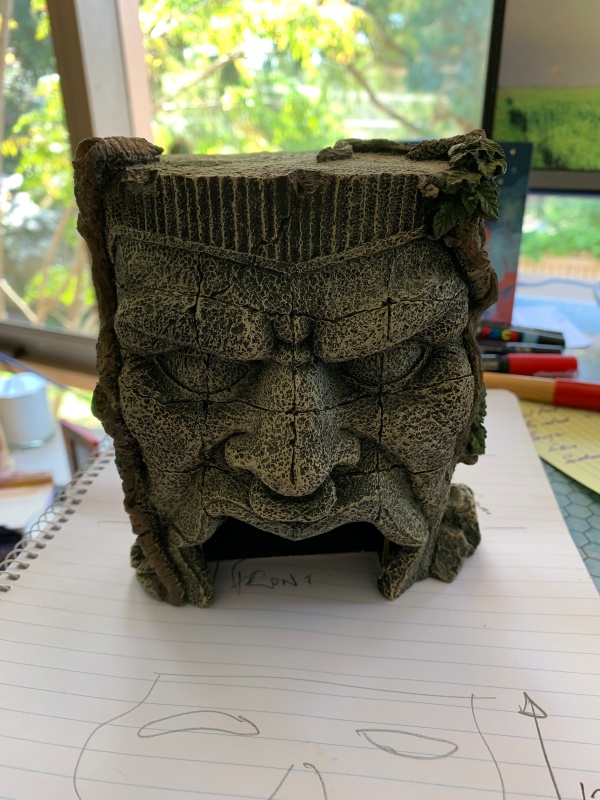
Same guys, ten minutes later
Posted 3 November, 2009 by shichitenhakkiCategories: Fantasy, Wargaming
They were sprayed with Mr Hobby Top Coat Flat Matt.
On the workbench, October
Posted 3 November, 2009 by shichitenhakkiCategories: Fantasy, Wargaming
Here is the latest bunch of old Battlemasters figures that I have given very simple paint jobs and then dipped in Wattyl Walnut Stain and Varnish. Basing is complete, but I have not given them a final matt spray. I will post again when this final step is done.
A parting
Posted 2 November, 2009 by shichitenhakkiCategories: Writing
Endlessly dividing things into smaller and smaller more acurate categories may be great for taxonomy but it also runs the risk of losing visibility, I think. Having noted my caution I am now doing it.
I have set up a new blog for a dfferent prupose. Where this blog talks about my gaming hobbies, the new one http://anboswell.wordpress.com/ is about my writing activities. I wanted to split these out as the book goes forward because the two topics are separate. Any potentials readers of the book may not be inetrested in wargaming. And wargamers should not be forced to endure talk of book production.
So there you are. Soon, back to some more gaming news.
Vanilla Twitter
Posted 19 October, 2009 by shichitenhakkiCategories: Fantasy, Writing
I have set up a Twitter account for Gustave for the lead up to publication. These passing days will be a blow by blow description of the impersonation of the Count of Nordheide, the mission immediately preceding the book. I hope to get in two postings a day until release date which, at this stage, sounds like it will be mid 2010.
The rationale for this first person narrative is that they are Gustave’s entries in his mental diary first thing in the morning and last thing at night – presumably the only times he has any free thinking time away from the hard study of being a spy and assassin under the control of his abusive father.
This is something of a writing experiment, of course. Can a story be told as it happens in no more than two sentences at a time and still be a story? They make stories out of reality TV, but for every minute of televised footage there is an awful lot of decision-making and editing. Not all footage is shown, and the reality is that most of life is routine. Not every action is imbued with meaning. The act of creating a story arc is the conscious process of not including a whole bunch of irrelevant clues. Can it be done live with no chance to edit? Don’t know. We’ll soon find out, though.
The name of the Twitter account is VanillaAssassin.
Vanilla update
Posted 15 October, 2009 by shichitenhakkiCategories: Europe, History, Writing
The Vanilla Assassin is gradually moving through the process, slowly but surely edging towards the shelves. I completed what I like to call the ‘final draft’ a couple of weeks ago incorporating some excellent feedback from my naturally talented editor friends. However, I fully expect to have lots more editing to do once the professional editors comb over it in detail. And I’m fine with that. In fact I relish the feeling that it is being read and there is interest in trying to make it better.
Now I am in the process of developing short stories to companion the main book to be sent to the many and varied short story markets. Once I have the ISBN for the coming book I can append that to the submissions, and hopefully they will reinforce each other.
So far I have a short piece where Gustave finds himself in Amsterdam during the first recorded stockmarket bubble, where entire fortunes were gambled and lost on the outrageously inflated prices of tulips. Strange, but entirely true.
Next, I am thinking of sending him to the Polish front, where the Ottoman Turks were having a go (http://en.wikipedia.org/wiki/Polish-Ottoman_War_(1633%E2%80%931634). The whole Turkish frontier fascinates me. The Turks besieged Vienna on two occaisions, once before Gustave’s time and the other later in the century – Baron Munchausen’s time, in fact. The border between the Holy Roman Empire and the Ottomans was ‘hot’. For their part the Ottomans were a true super-power. The rot that later crippled them had not yet gone all the way through, though it was in this century that European military technology and methods eclipsed them. During the early 1600’s, however, the issue hung in the balance. The Empire was desperate to keep the Turks out of the war raging within its borders. The incursion by the Transylvanians simply reeks of a Turkish set-up, and I reckon there’s a mission for Gustave in there as well.
Modular terrain
Posted 3 October, 2009 by shichitenhakkiCategories: Wargaming
This sequence shows the steps in making some modular terrain from expanded polystyrene. This is rather soft stuff so it required some bracing.
Having decided on the pieces I cut them out with a Woodland Scenics hot wire foam cutter. Then I angled the edges and gave them a bit of a wave just to break up the hard lines. To cover over the busted corner of the piece I sculpted a few boulders. This serves the double purpose of filling the gap and breaking up the unnatural regularity of the piece. With cardboard I made some sides and a bottom to give the pieces a little more resilience. There is no point in fooling myself, though. Foam gets beaten up and will have to be thrown away eventually. So there is no point in going all out. All we are looking for is something that is representative.
Next, I cut out a section that could be left open to be a makeshift trench, or a river valley, or a recessed road. Or if another tier of terrain sits on top it would be invisible. Using masking tape I protected the edges of the trench and cardboard sides to minimise the cardboard’s contact with the coming surfacing. Cardboard warps something awful. Over the top of this I painted a thin layer of Agnew’s Water Putty to tie it togther.
When dry I coated the whole thing in some domestic acrylic paint in an earth shade that I picked up in a sample pot from Bunnings. This gave a protective coat. Over this I then sprayed a few streaks of lighter khaki and red-brown just to break up the uniform colours. Next I dry brushed sand, grey and then white. Finally, I put a few patches of static grass and other different flock shades on the piece.
These pieces will not be totally flocked or themed for geographic location. My aim is to have them generic. The plan is to have separate pieces that sit on top to carry the message that the hill is forest, jungle, or desert.
Last of the Mohicans (movie) synopsis
Posted 28 September, 2009 by shichitenhakkiCategories: Colonial, History, Writing
In 1757 during the French and Indian War, the British and French are battling for control of North America. Though they are bound by law to join the militia to aid the British, many settlers are reluctant to leave their frontier homes and families defenseless against Huron Indians allied with the French.
Hawkeye (Daniel Day-Lewis), Chingachgook (Russell Means), and Uncas (Eric Schweig), the last of the Mohican tribe, visit the Cameron household. Jack Winthrop joins them and tells Hawkeye that he is gathering volunteers for the British army. The next morning, Jack and a group of others go to Albany to obtain terms from General Webb, who agrees to grant them leave if their homes are attacked. Satisfied, the volunteers join the British forces at Fort William Henry, north of Albany, New York.
Cora Munro (Madeleine Stowe) and her sister Alice (Jodhi May) have received word from their father, Colonel Edmund Munro (Maurice Roëves), the commander of the British garrison at the fort, to meet him there. A native guide named Magua (Wes Studi) and a detachment of British soldiers commanded by Major Duncan Heyward (Steven Waddington) escort the women on the trail. However, they are ambushed by Hurons led by Magua himself. All of the soldiers except Heyward are quickly killed. He, Cora and Alice are rescued by Hawkeye and his companions, who have been tracking the war band. Magua prepares to shoot Cora, but Hawkeye distracts him. With the rest of his men dead, Magua flees into the forest. The rescuers reluctantly agree to escort the survivors to Fort William Henry. Along the way, they discover that the Cameron homestead has been razed and everyone killed, though nothing has been stolen, a sure sign of a war party.
When they arrive at Fort William Henry, they find it under siege by the French. They manage to sneak inside. When Munro scolds his daughters for joining him, they realize that Magua has deceived them for unknown reasons. Munro tells Heyward that the fort can only hold out for three more days. Their only hope is to get a messenger through to General Webb at nearby Fort Edward for reinforcements.
Hawkeye tells the colonel and the colonials about the attack on the Camerons and the colonials demand that he release them to defend their homes, as General Webb agreed. Munro refuses, so Hawkeye covers for Jack and his friends so they can desert. Hawkeye, who stays behind to be with Cora, is arrested for sedition and sentenced to hang.
Several days pass. As the fort is on the verge of falling, the French commander, General Montcalm (Patrice Chéreau) offers Munro surrender terms, presenting a letter from General Webb that he can’t spare any forces. The garrison and their families are offered safe passage to Albany, on condition they return to England and no longer fight in the war. Munro reluctantly accepts, after Montcalm shows him an intercepted message that Webb has refused to send aid.
As the British march away, they are ambushed by a much larger force of Hurons led by Magua. Before Magua kills Munro, he tells him he will kill the colonel’s daughters so that his family will be extinguished; he then cuts out Munro’s heart. Earlier, it is revealed that Magua’s village had been destroyed years ago by British soldiers led by Munro, resulting in the death of his children and his wife marrying another man when she thought Magua was dead. Magua himself was made a slave.
Hawkeye, Cora, Alice, Uncas, Chingachgook, Heyward and two other soldiers escape and hide in a cave behind a waterfall, but Magua and his men are close behind. With their gunpowder wet, Hawkeye and his two companions jump into the falls, knowing their presence would precipitate a hopeless fight. Heyward and the two women are captured while the remaining soldiers are quickly dispatched.
The prisoners are taken to a Huron village, with Hawkeye, Uncas and Chingachgook in pursuit. Magua is bargaining with the sachem when they are interrupted by the arrival of an unarmed Hawkeye running the gauntlet of hostile warriors. With Heyward translating, Hawkeye convinces the chief that Magua is acting for himself, rather than the Hurons’ best interests and traditions. The chief agrees and renders his judgment: Cora is to be burned alive to atone for Magua’s dead children; Magua is given Alice to be his wife so that both bloodlines can continue; and Heyward is to be returned to the British in the hope of avoiding reprisals. Hawkeye is given safe passage in recognition of his bravery. Desperate, he demands they take him in Cora’s place. Heyward, out of love for Cora and newfound respect for Hawkeye, deliberately mistranslates, offering himself instead. When the chief accepts, Magua curses him and leaves with Alice and his men.
Uncas immediately follows the war band, while Chingachgook waits for Hawkeye. From a safe distance, Hawkeye shoots Heyward, ending his suffering. They then set off in pursuit of Magua.
Uncas catches up with Magua’s band alone. He kills several men before engaging Magua in single combat. Magua kills Uncas, dropping his body off a cliff. Alice then throws herself after him. A devastated Hawkeye, Chingachgook and Cora witness their deaths from a distance. Finally catching up, the two men slay several warriors. As Hawkeye holds the rest at bay, Chingachgook fights Magua and avenges his son.
In the final scene, Chingachgook and Hawkeye engage in a spiritual ritual to send Uncas’ spirit to his ancestors. With the death of Uncas, his last blood relative, Chingachgook names himself ‘the last of the Mohicans’.
White Snake House development
Posted 28 September, 2009 by shichitenhakkiCategories: Science Fiction, Writing
White Snake House is a political entity occupying a geographical region along the future Murray River centred roughly on the former region of Mildura. South of the Murray the [geological history] rising, then falling, course of the river has created a vast area of islands and marshes and is known as the Bay of Thousand Islands. Many different peoples occupy the islands – some advanced and cultured, others barbarous and primitive.
To the north, east and west of the territory controlled by White Snake House are other feudal-clan domains with whom they are in competition. Below them, in the Bay of Thousand Islands, they have many enemies, though few that are organised. The house attempts to subdue pirate activity, impose its own system of taxation and fiscal governance, enforce its own laws and ensure security for travellers and traders who attempt to make their way through the territory to the sea.
The house’s main access to the lucrative, and dangerous, sea is primarily down the Murray – past the site of the ancient ruins of Adelaide – and this zone is controlled by another house. Relations with this other house are primarily friendly, but it remains a strategic weakness. White Snake House continually seeks to mitigate this weakness by attempting to subdue the Bay.
Warfare for the regular military consists of two main duties:
- garrison to the east, west and north against the civilised foes in prepared defences such as walls, watch towers and so on
- amphibious operations to the south.